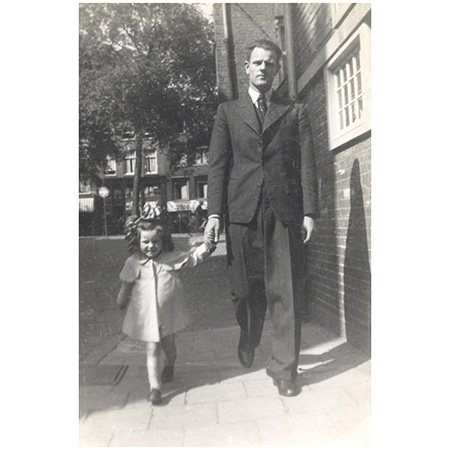
Walks with my father
When the World was engulfed in hatred my father taught me the power of Love and Awe. As I write this, hatred and attacks on anyone deemed “other” are trending again, and I flash back to my first memory of witnessing hatred in action. It was1942. My father enjoyed taking walks to visit his friends in the vibrant Jewish neighborhood of his beloved Amsterdam. I was four years old, when he took me with him, my small hand securely nestled in my daddy’s strong hand, to visit the “aunties” and “uncles”. Brought to a sudden halt by loud shouts and cries, I saw a family being dragged out of their home and loaded into a green truck. Saw a little girl, my age. Heard her desperate cries for the doll that had fallen on the pavement behind her. Saw the man would not let her go back for it, and I slipped out of my daddy’s hand to go pick it up for her. He pulled me back hard. “Henny, no,” swooped me up, buried my face in his neck and marched us home. His strong arms holding me tight, he whispered, “I will never let anything bad happen to you. I will always protect you.”
I was not fully aware of the evil that threatened the world until after my dad had been deported to a POW labor-camp in Germany, and my mother warned me that I must never tell anyone of the secret Jewish foster sister we hid in our home. I was five then and still believed in my daddy’s protective magic.
But when he returned two years later, I did not recognize the raging man filled with grief. He had not protected me as promised. He wasn’t there when my mom and I suffered brutality and almost died. I learned that war does not end when the peace treaty is signed. Its ghosts battle on in the broken hearts and tormented minds of those that survive.
I still see the cry in my dad’s tortured face, when after the war we took our first walk in the city that had been ours and we loved. My hand in his, the mournful silence of the once lively neighborhood of the “uncles” and “aunties”, his friends, now absorbed us. Their homes boarded up or inhabited by strangers. “It’s not my city. Not my city anymore.” His hoarse voice would echo in my ears decades later. “They’re all gone.” I felt his hand dampen and clench as if to hold me tight. “They slaughtered them all.” His grief drew me closer
Just a short walk away an attic stood empty where a young girl had been hiding. Her name was Anne Frank. I imagined I’d have met her had she lived and not died in a German concentration camp before age 16. She wrote about believing in human goodness. And I wondered why some choose to hate and others choose love.
“Hate is a disease. It kills,” my father said, his hand holding mine as we walked along the canal’s dark waters.
I was thirteen years old when my parents, fatigued by war memories and post-war economic struggles, seduced by promises of a new beginning, decided to immigrate to Australia.
In a desire for the freedom of wide-open spaces, my dad chose the desolate South Australian Mallee scrub desert to be our new home. Displaced and angry, I flew to Amsterdam in my dreams every night and refused to set foot in the one-roomed country schoolhouse I was told to attend. Once again, my father said, “Let’s take a walk.”
Under a darkening evening sky, we walked in silence, father and daughter in the empty scrub desert. Overhead the stars began to flicker and a million lights formed a sparkling dome. We stood in awe in a cosmic cathedral. In the deep stillness, I heard the voice of that timeless land. Then “Look,” my dad said pointing to the Southern Cross I had wanted to see. “We are all part of this. It’s all interconnected.” I put my hand in his and let his awe and love for the mystery of all things flow deep into my flesh and bones. It would continue to support me in my long complex life.
Many years later after he died from the cancer caused by cigarettes that had soothed the lingering trauma of war, he appeared to me in a time between sleeping and waking. Surrounded by white light, dressed in white clothing, unusual for the working man who preferred rolled up sleeves and blue overalls, he looked healthy and happy. Having seen him struggle with the aging of cancer, I exclaimed “Daddy, you are well. You are healthy. You can come back to us.” He smiled. A smile that needed no words. It told me he loved me. He said his good-bye. And I knew he was a man at peace with himself.
I miss him and on Father’s Day I will take a walk and imagine him holding my hand.