OPEN TURNS: From Dutch Girl to New Australian — a Memoir
by Hendrika de Vries
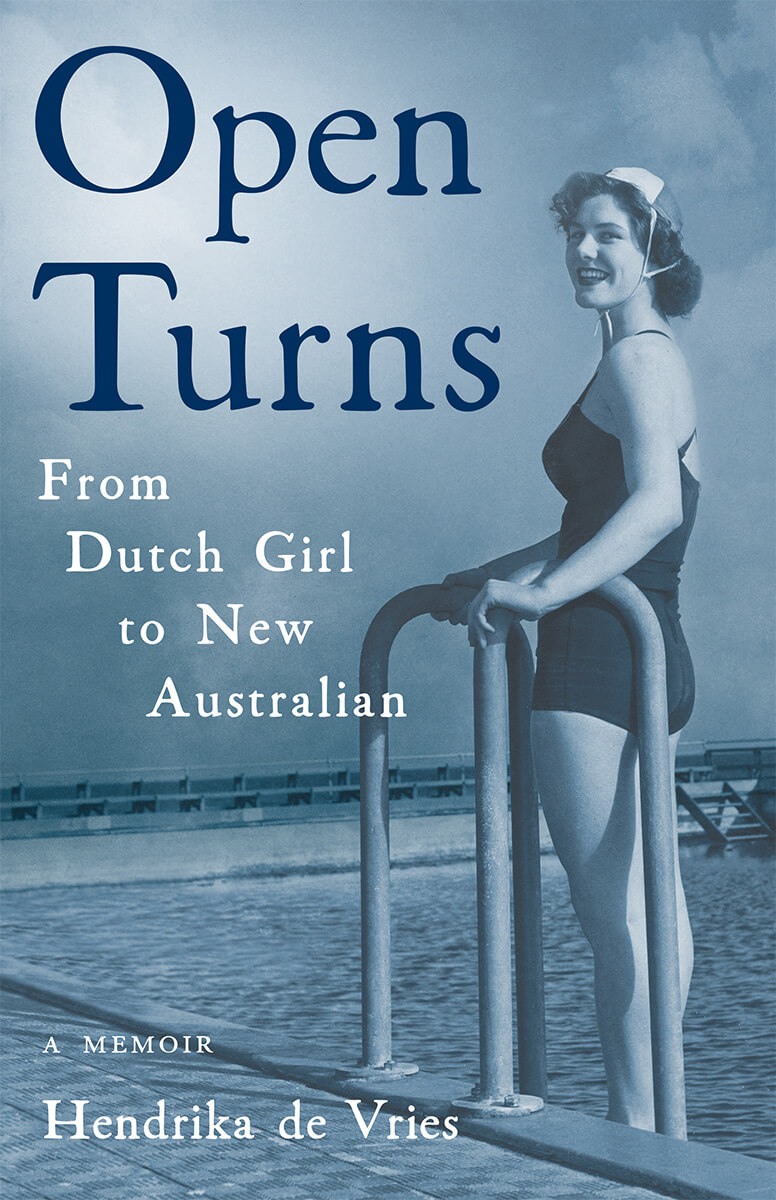
Henny was just a little girl when she experienced brutal violence and hunger in
WWII Amsterdam. But she is now a teenage immigrant swimmer in 1950s
Australia. She is smart, she swims fast, and she has definite opinions about the
kind of woman she intends to be––all of which serves her well in her new home,
where she must learn to turn challenges into success.
Her parents’ wisdom continues to guide her. “Intentions are like prayers; you
send them out into the universe and if you pay attention they come back as
destiny,” her mother says. And when she walks in the bush with her father, his
reverence for the mysteries of nature helps Henny hear the timeless Australian
Land speak and see the Southern Cross as a beacon.
She enjoys swimming fame and championship victories, but throughout her
coming-of-age years, she is also faced with memories, fears, and dashed hopes
and dreams. Time and again, she dives into the pool to find her own strength and
sense of belonging––until, finally, she begins to see more clearly her unique path
ahead.
Book Reviews

When I started reading the book I wasn't sure if the book was going to only focus on her swimming or also on her life away from the water. What I found was a book that didn't feel like a book. Instead, it felt like a conversation with an old friend where we spent the day looking back at where we came from and the path we took along the way.
I found myself both rooting for and in awe of Ms. de Vries and all her swimming accomplishments, but what most impressed me on the pages was her ability to capture all these little moments in her life and make them alive again for a reader that wasn't present (or in the same hemisphere) as the stories taking place.
Open Turns isn't just about the past. It is also about the present and future that the past helped create.
— Reviewed by Lucas Goodreads Review
De Vries’ memoir recounts her childhood in World War II–era occupied Holland and her teen years in Australia.
The de Vries acquitted themselves heroically in occupied Holland: Henrika’s (“Henny”) mother was part of the Resistance, and her father spent time in a German POW camp. When the war was over, the family accepted an offer to emigrate to Australia. Henny was not happy to leave Amsterdam, her friends, or her life as a very promising young swimmer. The family first fetched up in the Outback in a hovel, leading an existence that was just a cut above camping. But a couple of years on, they got to move to Adelaide, a city crazy about swimming; Henny began to fit in, make friends, and establish a name for herself as a formidable competitive swimmer—possibly Olympic material—until what was likely an undiagnosed iron deficiency blunted her winning edge. This was a crushing disappointment, but she was becoming more and more an Australian girl, a true “Sheila.” (“I belonged here in these waters Down Under, exactly at this time of my life.”) Henny later met and married a good man, and they (and their kids) moved to the USA. That marriage ended, but today she is a happily remarried Californian; it’s a wonderful arc of a life. This is a good book in so many ways: It is well written and tightly focused. Readers learn many details about life Down Under—Henny has an almost mystical moonlight encounter with a kangaroo. Other, less benign elements include endemic male chauvinism and casual xenophobia. In the author’s memories of Australia, women were meant for marriage and motherhood and were cloyingly patronized. And the de Vrieses would always be “New Australians”; decent people, perhaps, but not children of the heroic Australian past. But this little family survived the horrors of the Third Reich and a year of near starvation—they were made of sterner stuff.
A deeply felt memoir by a talented writer.
— Reviewed by Kirkus Review
Triumphs do not come in the form a young immigrant expected in the nuanced memoir Open Turns.
Hendrika de Vries’s moving memoir Open Turns is about facing postwar displacement and discrimination in Australia.
In war-torn Amsterdam, De Vries’s childhood was marked by violence, starvation, and strife. During her father’s stay in a prisoner-of-war camp, her mother, who was active in the resistance against the Nazis, struggled to care for their family. To better their prospects and escape a fractured postwar Amsterdam, the family emigrated to Australia when De Vries was thirteen.
In the memoir’s opening section, De Vries describes the prejudice, financial insecurity, and loneliness her family faced in their first years in the Outback. While De Vries was thrilled to return to city life when her family moved to Adelaide a year later, the move also forced her to acclimate to yet another new community. However, in Adelaide, she found joy in competitive swimming, winning state titles and swimming beside Olympians. Over the next decade, she began to make a life for herself in Australia, completing business school, making lifelong friends, and finding romance and a successful career as a secretary. In time, she achieved her childhood dream of working in a newsroom, contending with sexist social norms and anti-immigrant prejudice to do so.
About carving out a home in the face of unexpected challenges, this is an inspiring memoir whose prose is marked by wit, charm, and humor. The narrative is told through immersive vignettes from the point of view of De Vries’s adolescent self that highlight her individuality and resilience. In an early scene, De Vries recounts her first day of school in Australia, when her vivid description of the flying fish she saw on her journey from Amsterdam was met with disbelief and condescension from her classmates. Rather than permit further humiliations, De Vries decided to complete advanced coursework via mail from a high school nearby, furthering her education on her own terms.
By focusing on small moments from De Vries’s childhood that changed the course of her life, the book honors the nuance and texture of everyday experiences. Further, it portrays her adolescent concerns with respect, interspersing them with rear-gazing insights from De Vries’s adult perspective. She felt uncertain, lost, and confused in her youth, and this disorientation is placed in the compelling context of her immigrant experiences for greater nuance.
Ending with De Vries’s choice to emigrate yet again to build a new life with her husband in the US, the book’s conclusion is optimistic. It includes a lyrical ode to Australia and the experiences and people that enriched her life there. In a call back to an earlier sequence in which the spirit of Australia spoke to De Vries in a dream, a powerful message is delivered to other women: “You have not yet become the woman you will be. There is more to be discovered. Do not be afraid.”
An affecting and powerful coming-of-age memoir, Open Turns is about an immigrant finding a place to call home a world away from where she began.
— Reviewed by Bella Moses, Foreword Reviews